

The two major US print-on-demand publishers, Amazon KDP Print and IngramSpark, have real, published, and meaningfully different margin and gutter requirements. Knowing both matters if you're distributing through more than one, once you're ready to export a print-ready PDF from Deckle.
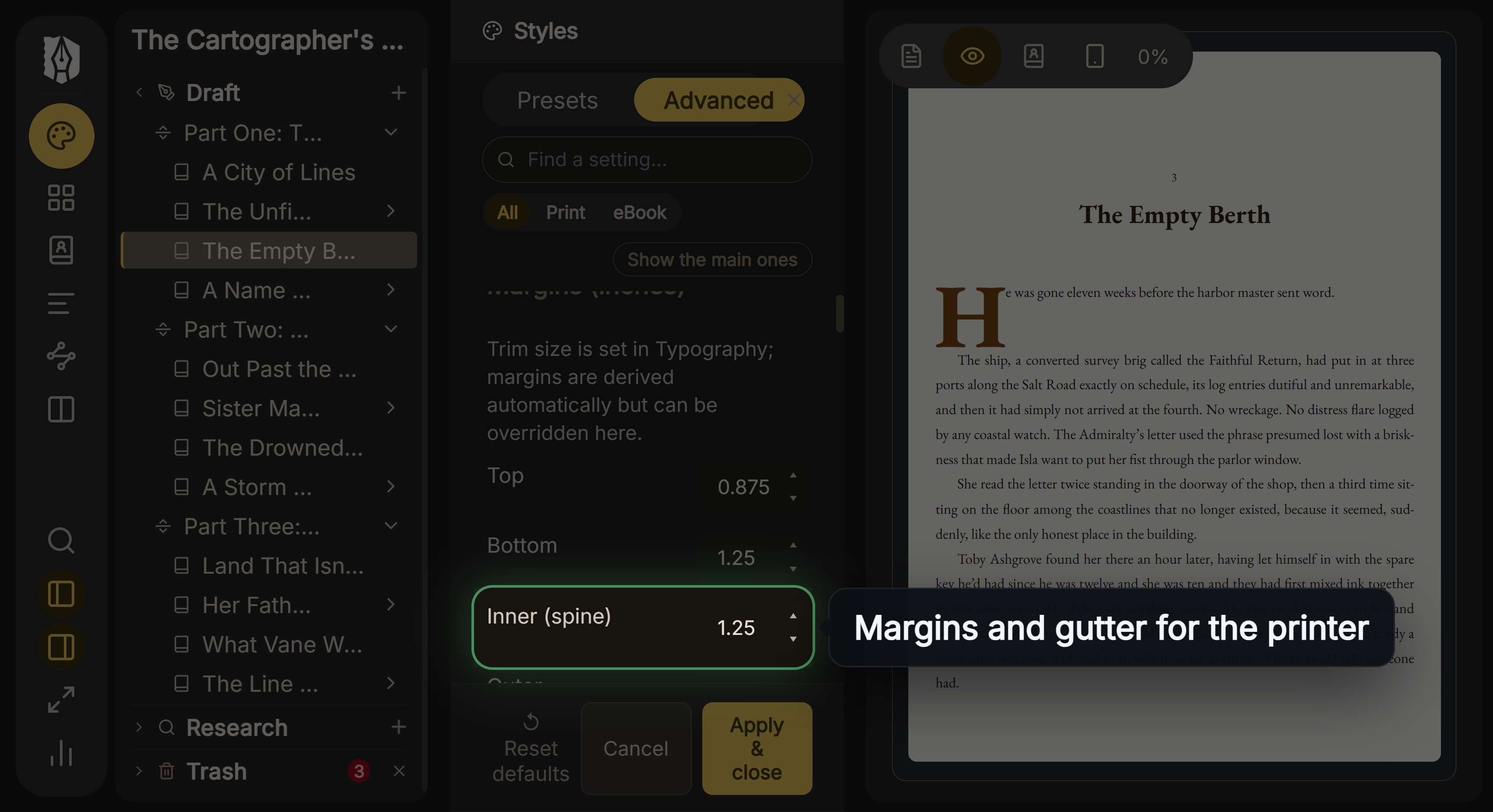 Print margins and bleed
What You'll Need
- A finished manuscript with a known final page count, since gutter margin requirements are often based on it.
- A decision on which platform(s) you're printing through, since their requirements aren't identical.
KDP Print Requirements
Trim sizes. Standard sizes from 5"×8" up through 8.5"×11", plus larger sizes up to 8.27"×11.69".
Outside margin. At least 0.25" without bleed, or 0.375" with bleed enabled.
Inside (gutter) margin, scales with page count:
| Page count | Inside margin |
|---|---|
| 24-150 | 0.375" |
| 151-300 | 0.5" |
| 301-500 | 0.625" |
| 501-700 | 0.75" |
| 701-828 | 0.875" |
Bleed. 0.125" beyond trim size on edges where content bleeds to the page edge.
IngramSpark Requirements
Trim sizes. IngramSpark's most common paperback sizes are the same three standards most authors use: 5"×8", 5.5"×8.5", and 6"×9".
Margins. A flat minimum of 0.5" on all sides for non-bleeding text and art, notably larger than KDP's minimum.
Gutter (bind side). A separate 0.125" no-ink strip on the bind edge, in addition to the 0.5" margin, not a page-count-scaled table the way KDP does it.
Bleed. 0.125" on top, bottom, and outside edges only, never on the bind/gutter side, since that would misalign the binding.
Printing tolerance. IngramSpark allows about 1/16" (0.0625") of variance in the actual print/trim process, so content placed right at the edge of your margin has less real safety room than the number implies.
The Real Difference Between the Two
KDP scales its inside margin requirement up as your page count grows, on the logic that a thicker book needs more room near the spine to stay readable after binding. IngramSpark instead uses one flat 0.5" margin plus a fixed 0.125" gutter strip, regardless of page count. If you're publishing through both, design to IngramSpark's flatter, generally larger minimums and you'll clear KDP's requirement too for most books. The reverse isn't guaranteed for longer manuscripts.
A Couple of Things Worth Knowing
💡 KDP's gutter table tops out at 0.875" for 701-828 page books. A book at exactly the edge of a bracket (e.g. 150 or 300 pages) should round up to the safer margin if you're unsure which side of the line your final page count lands on.
💡 IngramSpark's printing tolerance means "just barely inside the margin" isn't actually safe. Build in more room than the stated minimum if content near the edge matters (like page numbers or running headers). See Styling Your PDF for Print Publication for how to actually set these margins in Deckle.
FAQ
Do KDP and IngramSpark require the same margins?
No. KDP scales its inside (gutter) margin by page count, while IngramSpark uses one flat 0.5" margin plus a separate fixed gutter strip. They're not interchangeable.
What bleed amount do both platforms want?
Both use 0.125" of bleed on the edges where content extends to the page edge, though IngramSpark explicitly excludes the bind/gutter side from bleed.
If I'm publishing on both platforms, whose requirements should I design to?
IngramSpark's flatter minimums are generally larger, so designing to those specs will typically also clear KDP's requirements, but check both directly for your specific page count rather than assuming.