

The European Accessibility Act (EAA) came into force on June 28, 2025, and requires ebooks sold in the EU to meet real accessibility standards, EPUB Accessibility 1.1 and WCAG 2.1 Level AA, not just a general "make it readable" guideline.
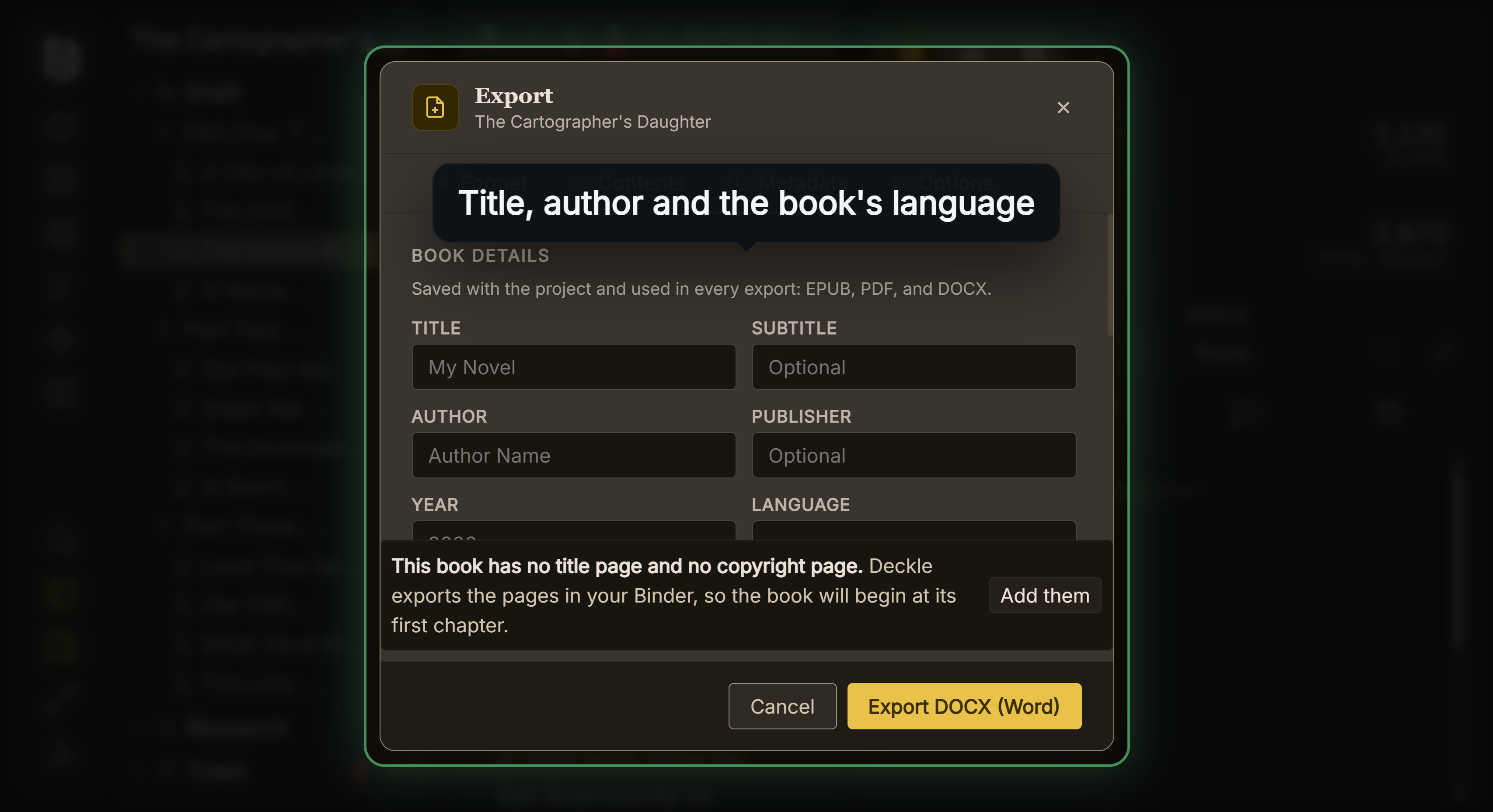 Book details and language
What You'll Need
- An EPUB built on EPUB 3 (not EPUB 2), since EPUB 2 lacks the structural and metadata support the accessibility standard requires.
- A plan for writing meaningful alt text on your images: this is something only you, the author, can provide; no export tool can generate it for you.
What the EAA Actually Requires
Who it applies to. Anyone selling ebooks into the EU market, regardless of where the author or publisher is based. It's about where the book is sold, not where you live.
What standard it points to. The EAA doesn't invent its own rules; it references two existing standards: EPUB Accessibility 1.1 and WCAG 2.1 Level AA.
Timeline. New (frontlist) titles needed to comply from June 28, 2025. Existing (backlist) titles have a five-year grace period, with a compliance deadline of June 2030.
Concrete technical requirements, per the W3C's own EPUB-to-EAA mapping: a proper table-of-contents navigation structure, alternative text for all non-text content (images), adequate color contrast, resizable text and adjustable spacing, reading order that makes sense to assistive technology, and accessibility metadata describing the book's features so a reader can tell it's accessible before buying it. DRM, if used, can't block any of this.
The Small-Business Exemption Is Genuinely Unclear: Don't Assume Either Way
You'll find confident claims on both sides of this online. The EAA does include a "microenterprise" exemption (businesses with fewer than 10 employees and under €2 million annual turnover), which would cover most solo self-published authors. But multiple industry sources draw a real distinction between the exemption applying to service providers (the storefront/app itself) versus the content (your actual ebook file), meaning the exemption may not let an individual author's book off the hook even if the author themselves qualifies as a microenterprise.
This isn't settled enough for a wiki article to state a confident answer either way. If EAA compliance matters for your specific situation, check your distribution platform's own current guidance (KDP, Apple Books, Kobo, etc. each publish their own compliance statements) or talk to someone who can advise on the actual current legal position, rather than treating anything here, or on most blogs covering this topic, as final.
A Couple of Things Worth Knowing
💡 EPUB 3 is a prerequisite, not a guarantee. Using EPUB 3 markup gets you the structural foundation accessibility features need, but doesn't automatically make a book compliant: alt text, accessibility metadata, and genuine reading-order sense still have to be actually present.
💡 Alt text is the one requirement no tool can do for you. Structural/technical requirements can be handled by your writing/export software; meaningful image descriptions have to come from you. See Styling Your EPUB for KDP and Other Platforms for exactly where to add it in Deckle.
FAQ
Does the European Accessibility Act apply to me if I'm not based in the EU?
Yes, if you sell your ebook into the EU market, the EAA is based on where the book is sold, not where the author or publisher is located.
Do older, already-published books need to comply immediately?
No. Backlist titles have a five-year grace period from June 2025, with a compliance deadline of June 2030. New titles needed to comply starting June 28, 2025.
Am I exempt because I'm a self-published, one-person author?
Possibly, but it's genuinely unclear. The EAA's microenterprise exemption may apply to service providers rather than to your book's content specifically. Check current guidance from your distribution platform rather than assuming either way.