Write · Format · Publish ◆ Windows · Mac · Linux
Everything Scrivener does for your draft. Everything Vellum does for your finished book. From your first line to a store-ready file for Amazon, Apple Books, and Kobo, in one app: no export, no import, and a finished novel out in about a second.
One-time payment. No subscription. Yours forever.
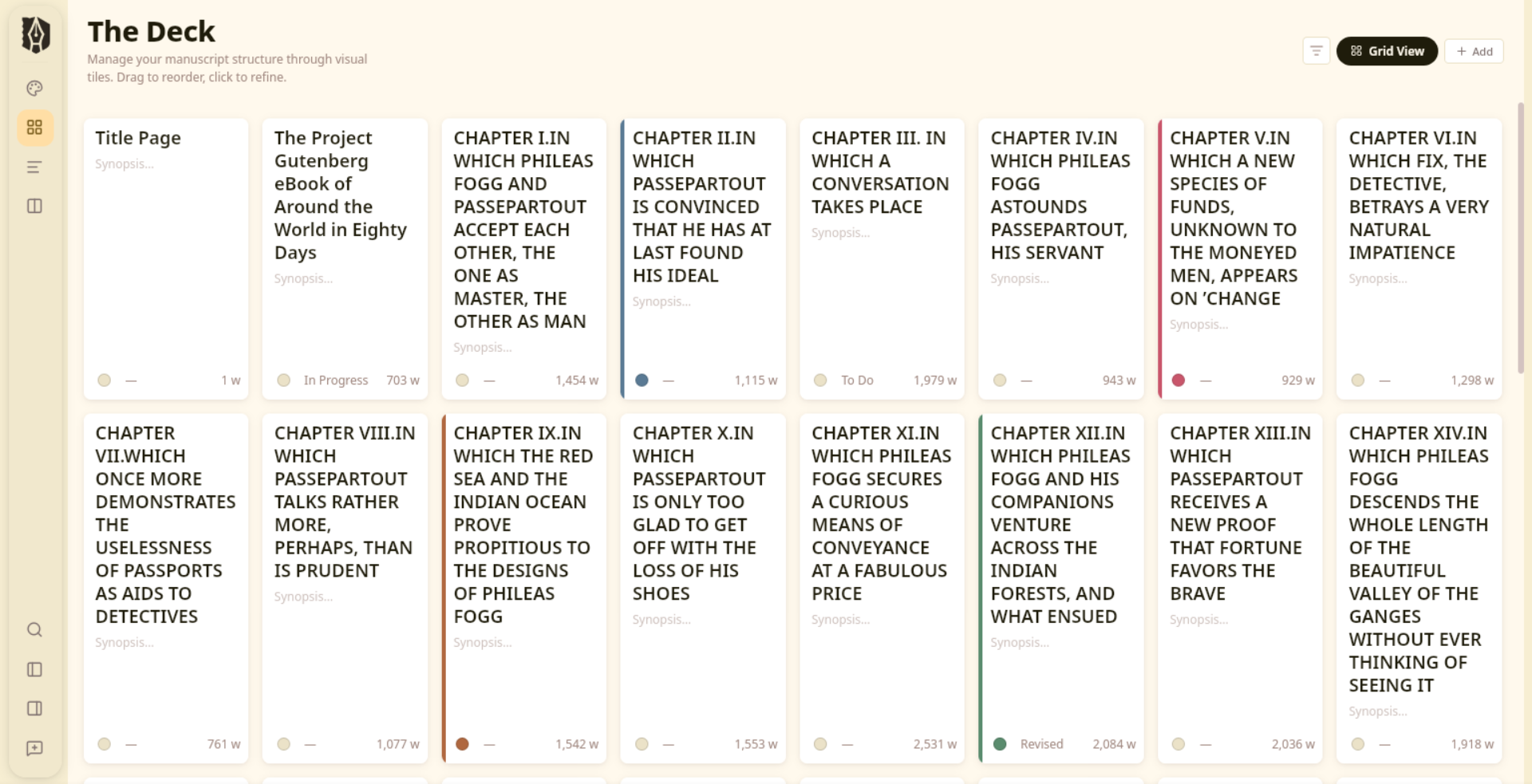
Your entire manuscript. Every chapter, every note, one place.
Trusted by authors & reviewers
Reviews
"I genuinely really love how they've combined the best features of all the writing software that exists and make it even more customizable."
"I only published my preview of Deckle last week, but they've already added a bunch of new features... still shaping up to be a really promising writing tool."
"Deckle Studio is a fantastic, refreshing alternative. For indie authors looking to streamline their workflow and publish more books with less friction, Deckle Studio is absolutely worth considering."
"It does everything Vellum does on a Mac and it is cheaper. No brainer."
"The ease of importing my projects, the speed and simplicity of the interface, and the combination of power and effortlessness in the export are all deeply appealing."
"Deckle is everything I have ever wanted in a writing program, combining the functionality of Scrivener with the user friendliness of Lore Forge."
"Deckle is the all-in-one writing, formatting & self-publishing tool I was dreaming of."
Tutorials
"Deckle combines the organizing capabilities of Scrivener with the robust publishing tools of Vellum, and the price is hard to beat."
More walkthroughs on their way: setup, Scrivener import, formatting, and export.
Made a Deckle video? We'd love to feature your walkthrough here.
As covered by
"Bridges the gap between deep creative engineering and high-end publishing aesthetics. Incredibly fast, simple to navigate, and respects your privacy."
YouTube Review"A solid alternative to Scrivener and Vellum — all in one place, offline, and at a fraction of the combined cost."
Article Review"Deckle is the first time in over a decade that something has caught my eye which offered an alternative to Scrivener."
More reviews on their way. Deckle is being put through its paces by authors and bloggers across the writing community.
Stop before you buy
Scrivener
$59.99
Writing only. $95.98 if you want it on both Mac and Windows: they are separate licences.
+ Vellum
$249.99
Formatting only. macOS only. There is no Windows version and no Linux version.
Deckle
$197
Both jobs, one app. Windows, Mac, and Linux. Every future update included.
That is $309 to $344 for two programs that don't talk to each other. Write in one, export, import into the other, format, export again, and then repeat that entire loop every time you change a sentence. Deckle is $197 once, and your manuscript never leaves the window you wrote it in.
Built on four promises every author deserves
Your work remains private and under your control. Export to DOCX any time, or open your project files with any text editor. You're never locked in.
Deckle autosaves on every keystroke, not every few minutes: every single keystroke. No Ctrl+S. No "did I save that?" No lost scenes. Your manuscript is always exactly as you left it.
One price. Every feature in the app. All future updates included, forever: no paid version upgrade the way Scrivener 2 owners had to buy Scrivener 3. No renewal notices. No "upgrade to export." What you buy today is yours for life, backed by a 30-day, no-questions-asked refund.
Write. Organise. Research. Revise. Format. Publish. No switching between apps. No importing and exporting. No second app waiting for you at the end: everything your novel needs is right here, in one window.
You start in Word. By chapter five you're lost: scrolling endlessly, no structure, no sense of the whole. Word was built for memos. Not novels.
So you try Scrivener ($59.99, or $95.98 if you want it on both Mac and Windows, because those are separate licences). The binder is excellent for organising your manuscript. But when it's time to publish, you hit a wall: the compile feature can be complex to configure, and most writers end up buying dedicated formatting software on top of it. Vellum ($249.99, macOS only) or Atticus ($147, browser-based). Now you're managing two tools, two workflows, and two sets of files, every time you want to see how your book will look in its finished form.
That combination is what the internet recommends, and it costs $309 to $344. Tools that excel at writing stop before the publishing stage. Tools built for publishing don't include writing features. And the handoff between them is never seamless: it's an export, an import, and a re-check of every page, repeated on every single revision.
"I just want to write my novel and publish it. Why does this require multiple pieces of software?"
Deckle was built to answer that question. The one place to write, format, and publish your novel, nothing left out, for $197: less than Vellum costs on its own, on Windows, Mac, and Linux.
Already in Scrivener?
You don't start over. Deckle imports your Scrivener project directly: chapters, scenes, synopses, notes, and research all come with it in one step.
Screen recording of a real Scrivener import, no audio.
Common frustrations with other writing tools
Powerful software with many options, but the compile feature has a reputation for being challenging to set up. Many writers find they need a second tool to achieve the professional output they're looking for.
Vellum's output is genuinely beautiful, and that is the whole of what it does. No binder, no scene hierarchy, no codex, no timeline, no research folder, no writing stats, no focus mode. You still buy a separate app to write in. And it costs more on its own than Deckle costs for everything.
Atticus is a Progressive Web App that runs in Chrome. Your book lives on their servers, and offline mode has limitations: you can't import, export, or save locally without reconnecting first.
No binder. No scene hierarchy. No corkboard. No synopses. Excellent tools for documents. A 90,000-word novel is not a document.
The standard recommendation for serious self-publishers: Scrivener to write, Vellum to format. Both are strong products. But that's $309 minimum, $344 if you want Scrivener on both Mac and Windows, two separate learning curves, and an export-import round trip every single time you want to see your book's final appearance.
Years of work, organised exactly how you like it. The thought of rebuilding your project from scratch in a new app is enough to keep most writers stuck where they are, even when the tool isn't working for them.
Vellum runs on macOS only, and its makers have said a Windows version isn't planned. If you write on Windows or Linux, the tool everyone recommends simply isn't available to you: your options are buy a Mac, rent a cloud Mac at $490–$670 in year one, or use something else. Scrivener dropped its Linux build too.
With Scrivener plus Vellum, your manuscript only becomes a book after you export it and import it somewhere else. Vellum's preview lives inside Vellum, a different application from the one your draft is in. Checking a single page break means running the whole round trip again.
Scrivener is sold as a one-time purchase, but major versions have historically cost money again: Scrivener 2 owners paid to move to Scrivener 3. What you spend today isn't necessarily the last thing you spend, and Mac and Windows are billed as separate licences on top of that.
The Complete Author's Studio
Deckle is two products in one, and both halves are finished. The writing half does the work you would buy Scrivener for. The publishing half does the work you would buy Vellum for. They share one window and one file, and hand off to each other with nothing in between.
The writing half · what you'd buy Scrivener for
Vellum has none of these. It is a formatting tool, not a writing tool, which is exactly why people who buy it also buy Scrivener.
The publishing half · what you'd buy Vellum for
Scrivener stops before this. That handoff is the reason most Scrivener users end up spending another $249.99.
The Manuscript
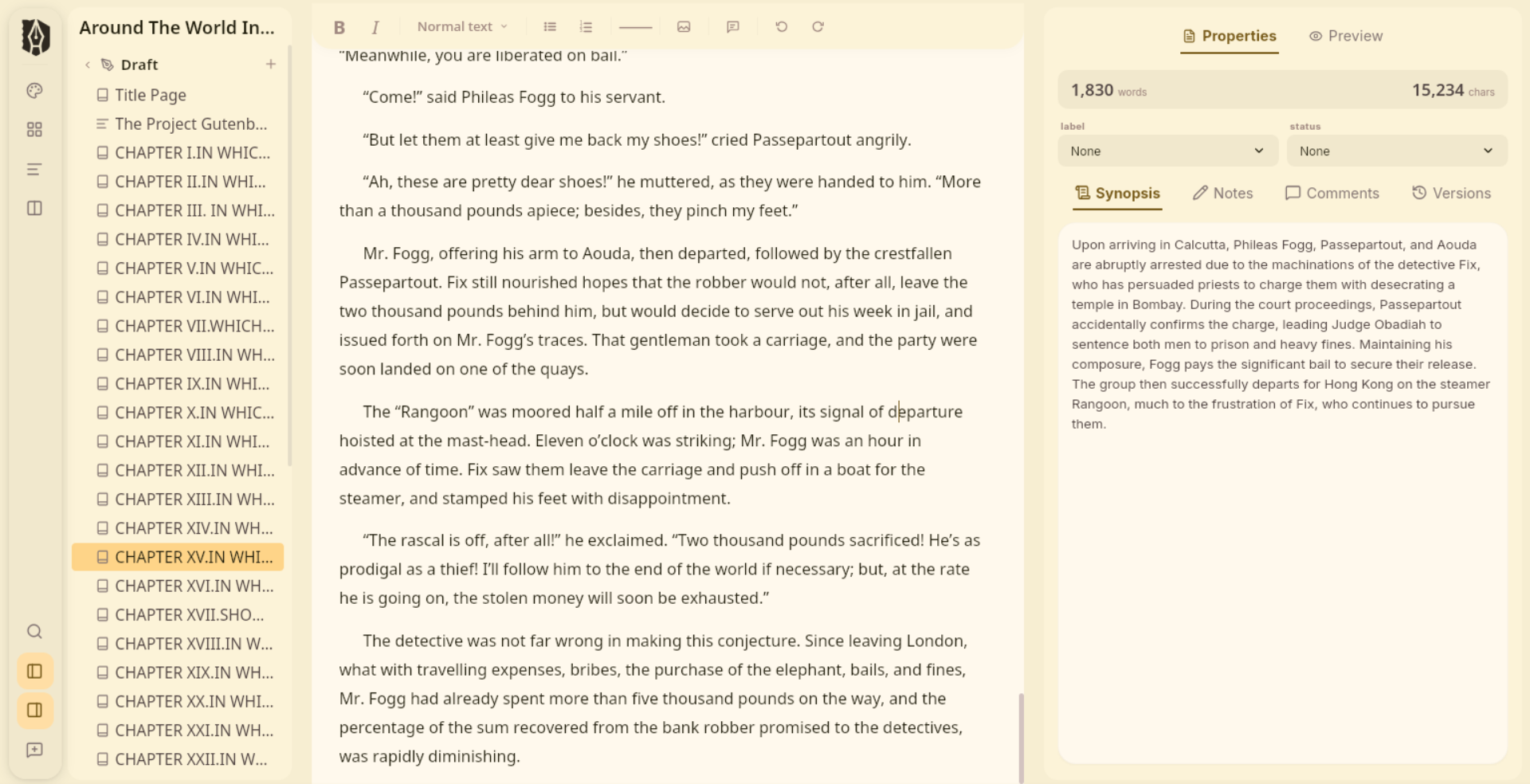
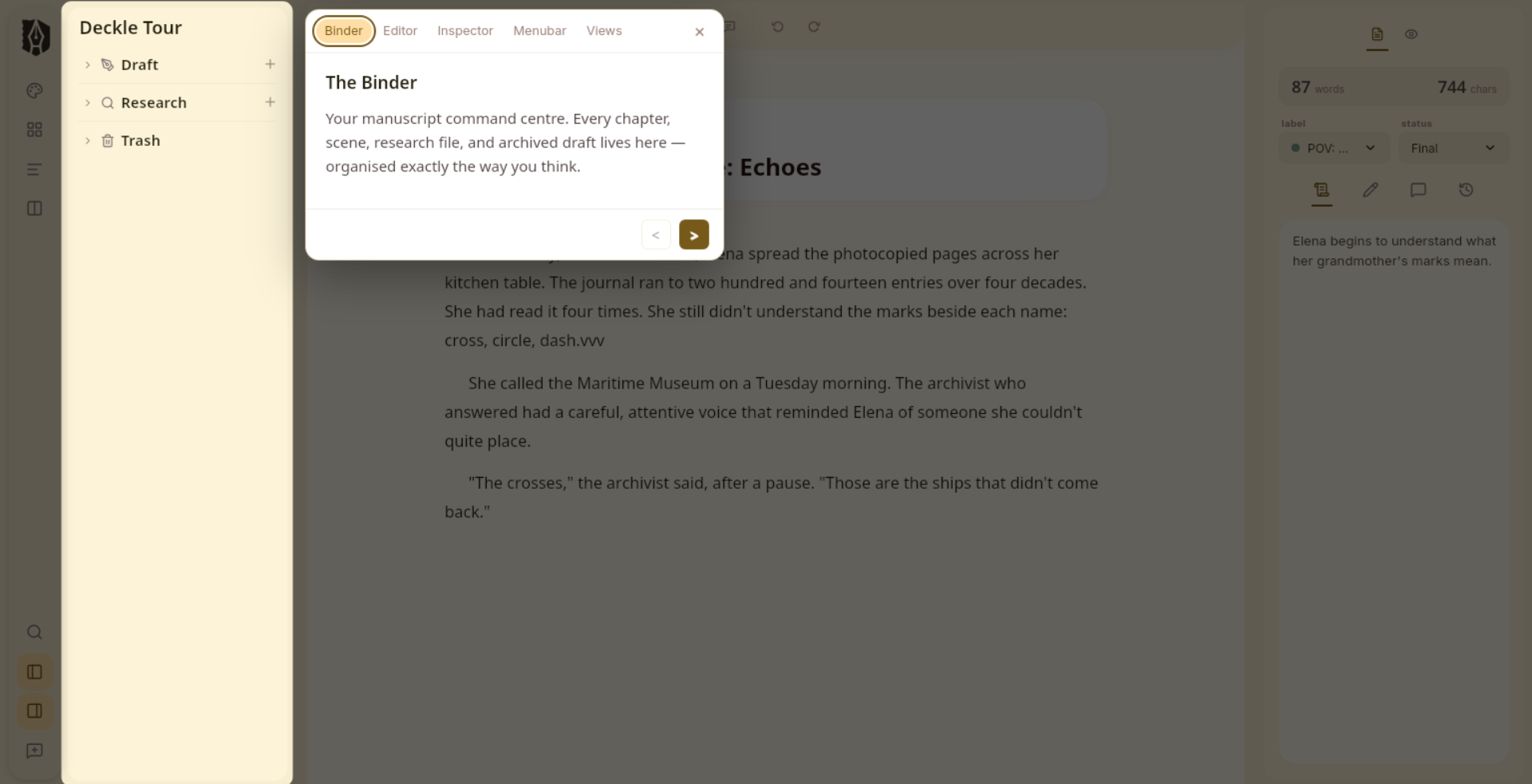
The Binder organises your novel the way a novel actually works: chapters, scenes, notes, and research in a clear, navigable hierarchy. Drag to reorder. Nest scenes inside chapters. See everything at once.
The Editor
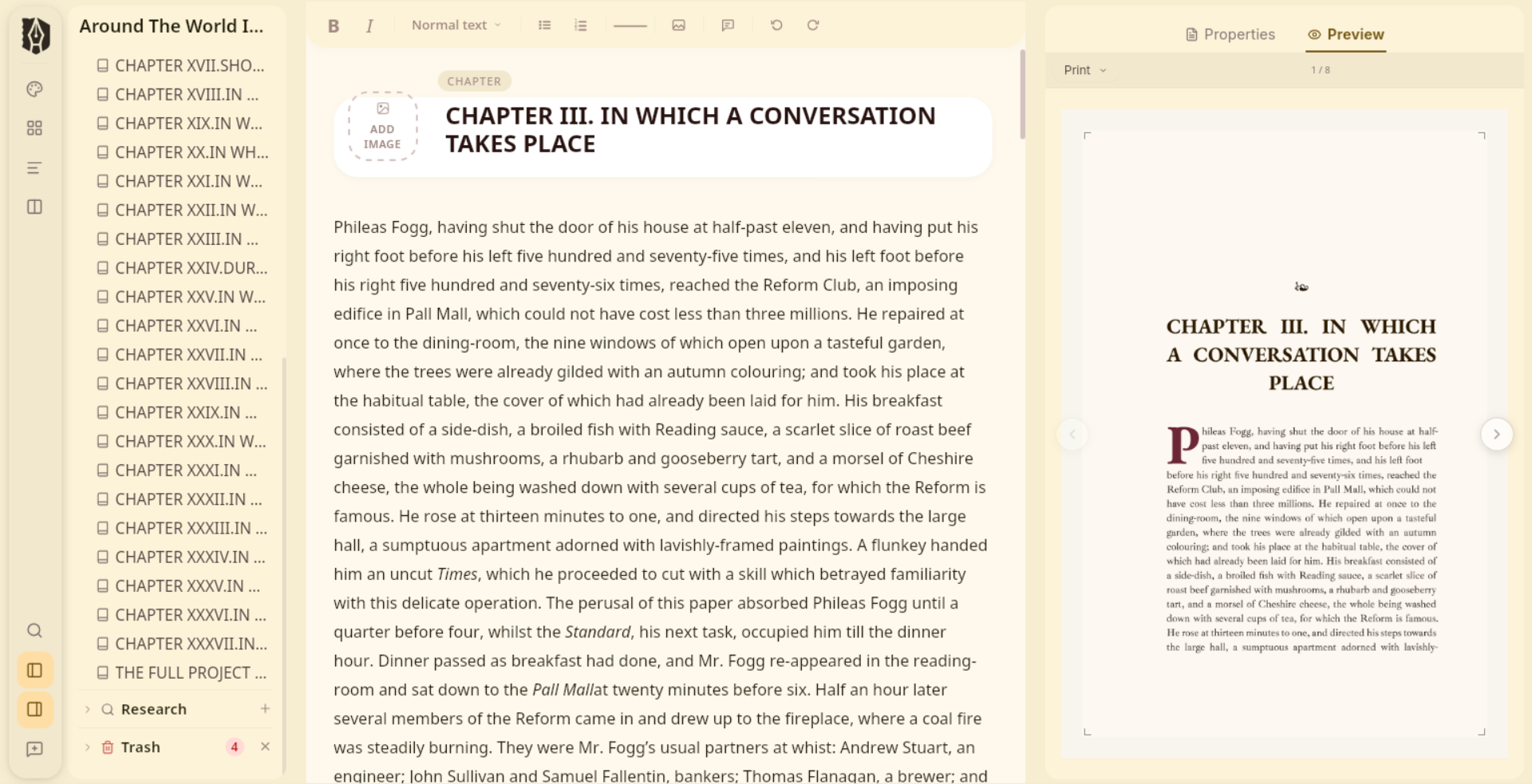
Deckle's editor understands what a novelist needs. Blocks for verse, dialogue, found letters, and epigraphs. Comments anchored to your text: paragraph-level or selection-based. Named snapshots so you can restore any previous draft with one click. Every keystroke saved automatically: you never have to think about it.
Focus Mode
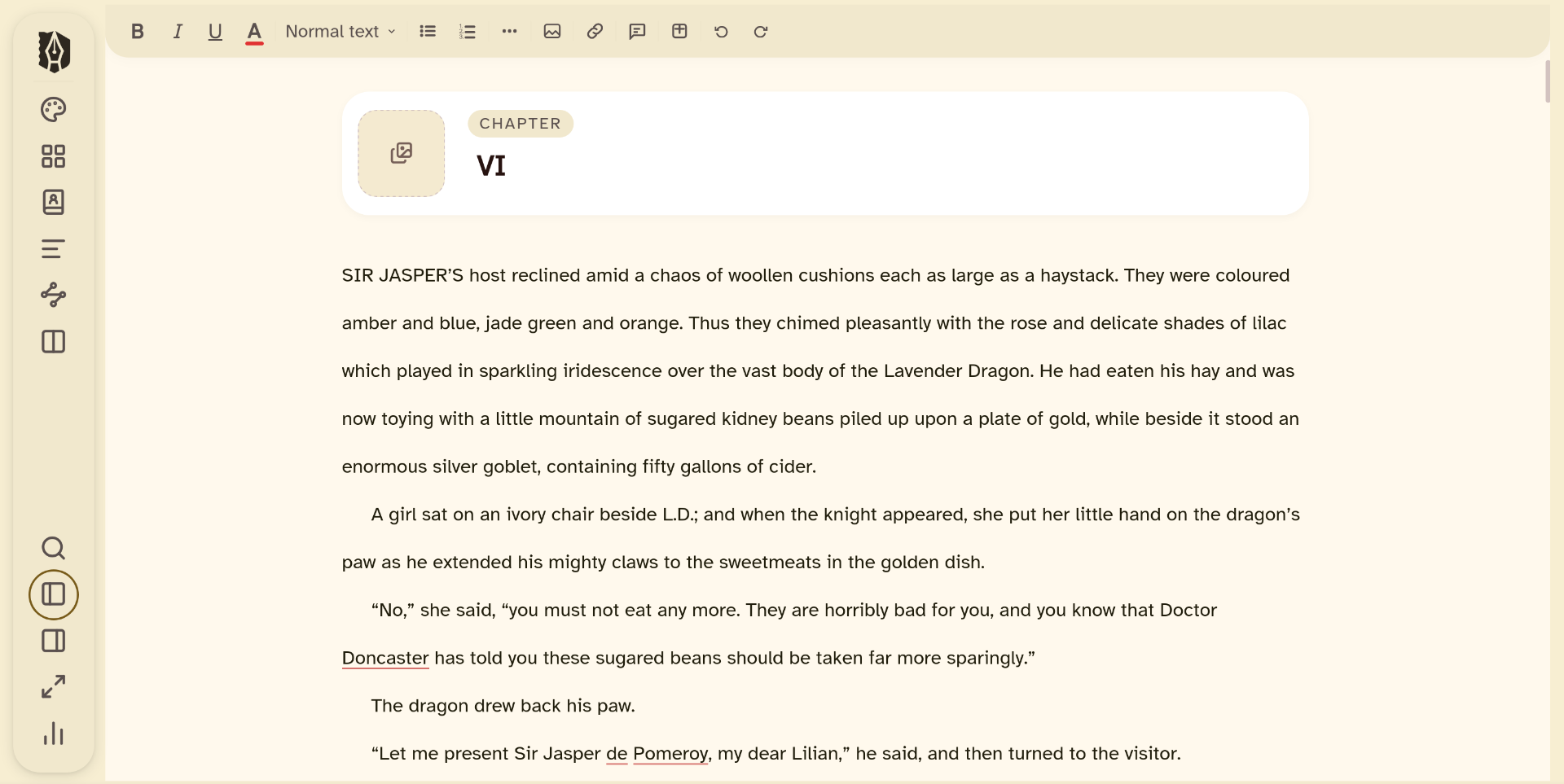
No sidebar. No inspector. No panels of any kind. One click clears everything away except your text, so the only thing left on screen is the sentence you're actually writing.
The Workspace
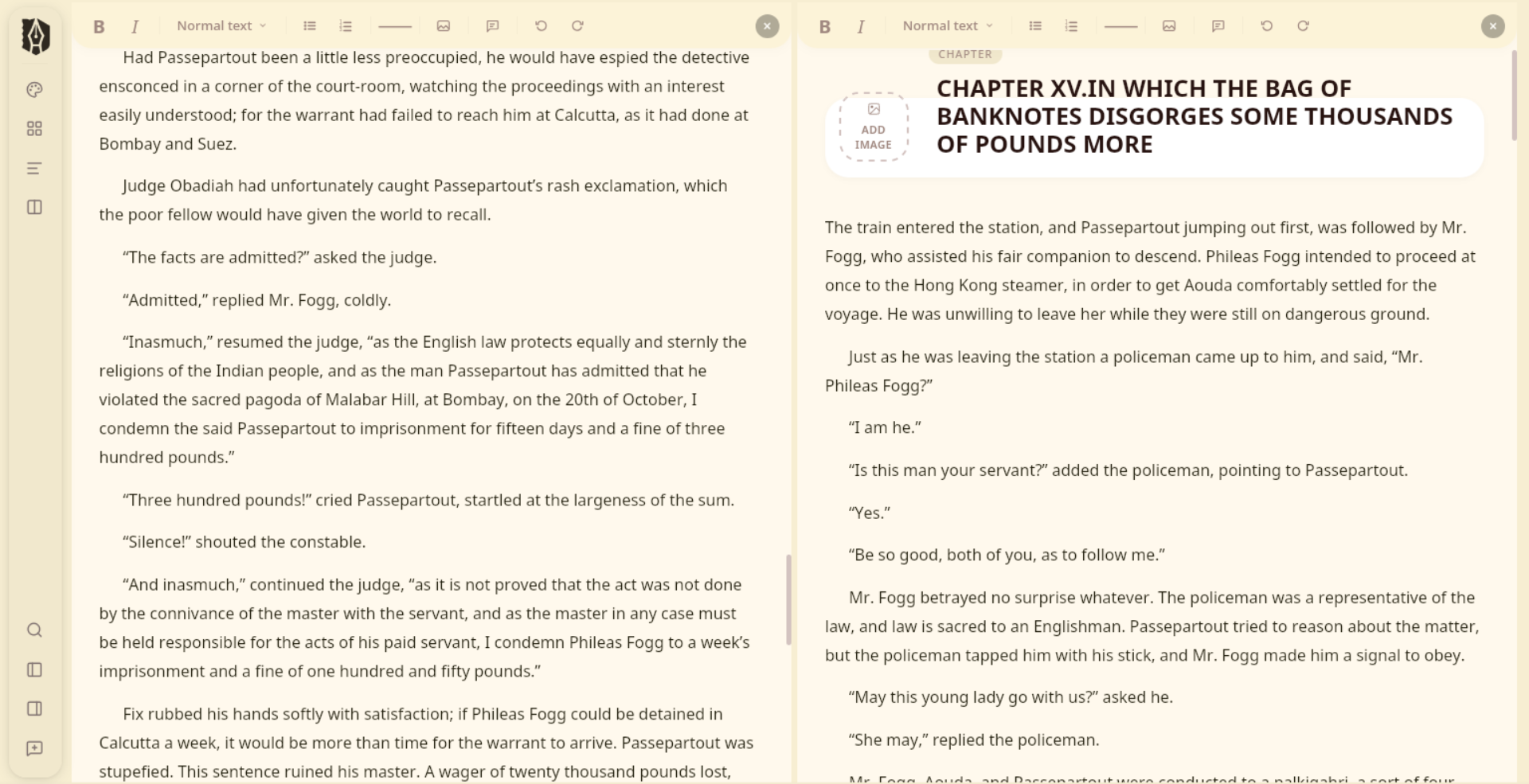
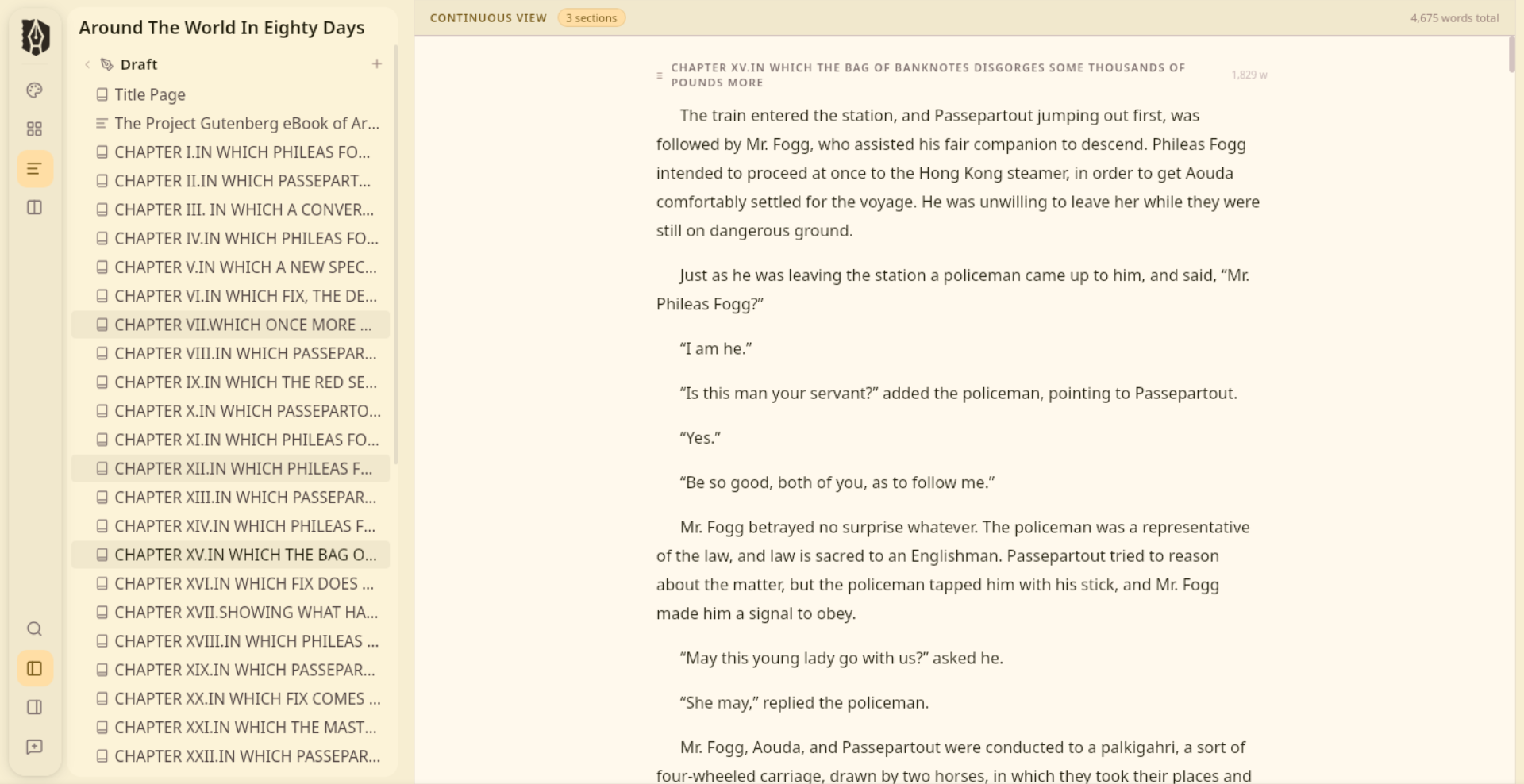
Drafting, plotting, revising, and planning each demand a different view of your novel. Deckle gives you four: one click away, always.
The preview runs the actual export compiler. What you see is exactly what your readers will get, not an approximation.
Continuous View: your full manuscript in one unbroken scroll
The Research Room
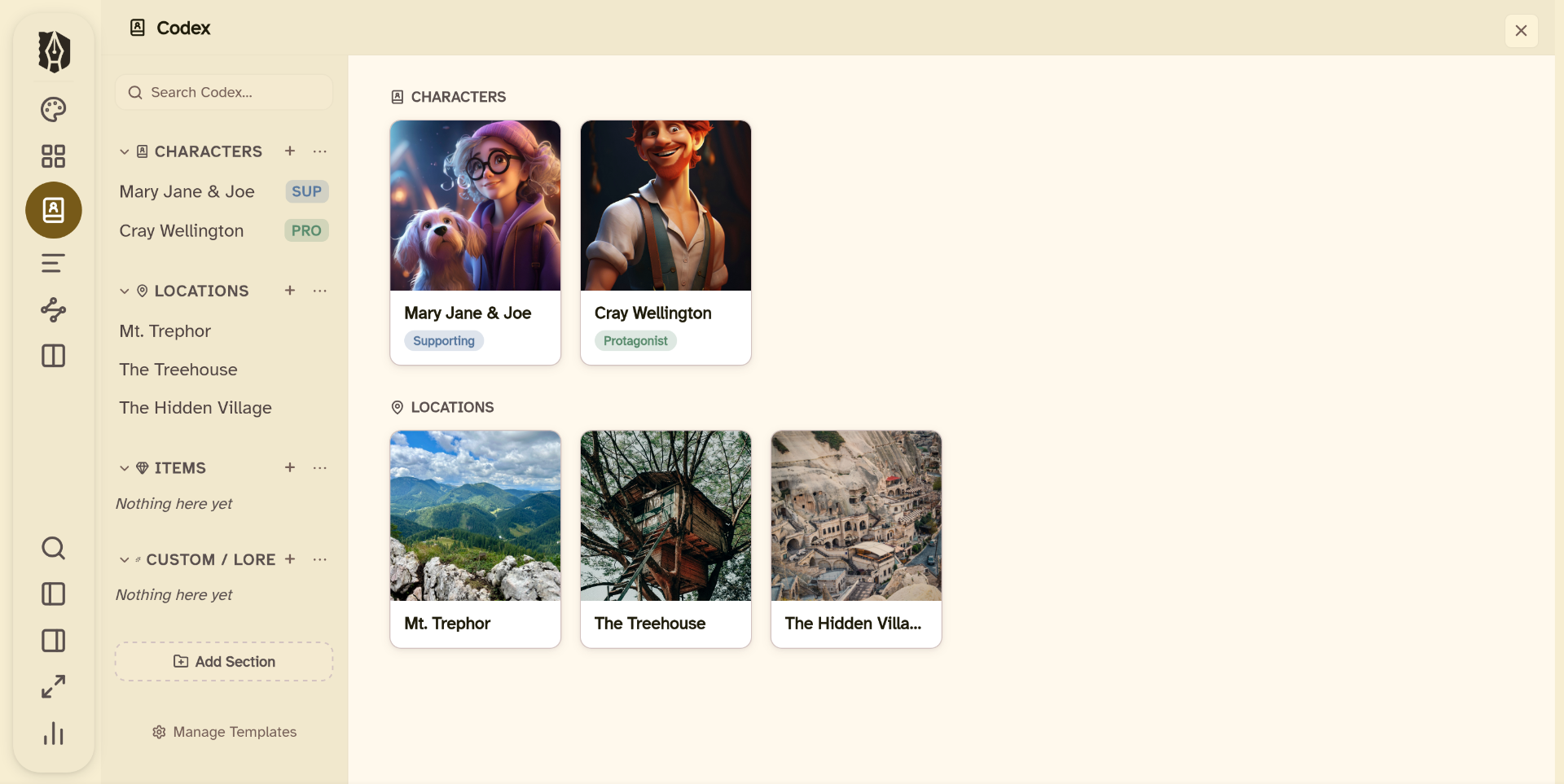
Character sheets, location profiles, PDFs, images: kept inside Deckle, always one click from the scene you're writing. Your research lives alongside your manuscript. No external folders. No lost files.
The Codex: structured character and location entries, right beside your manuscript
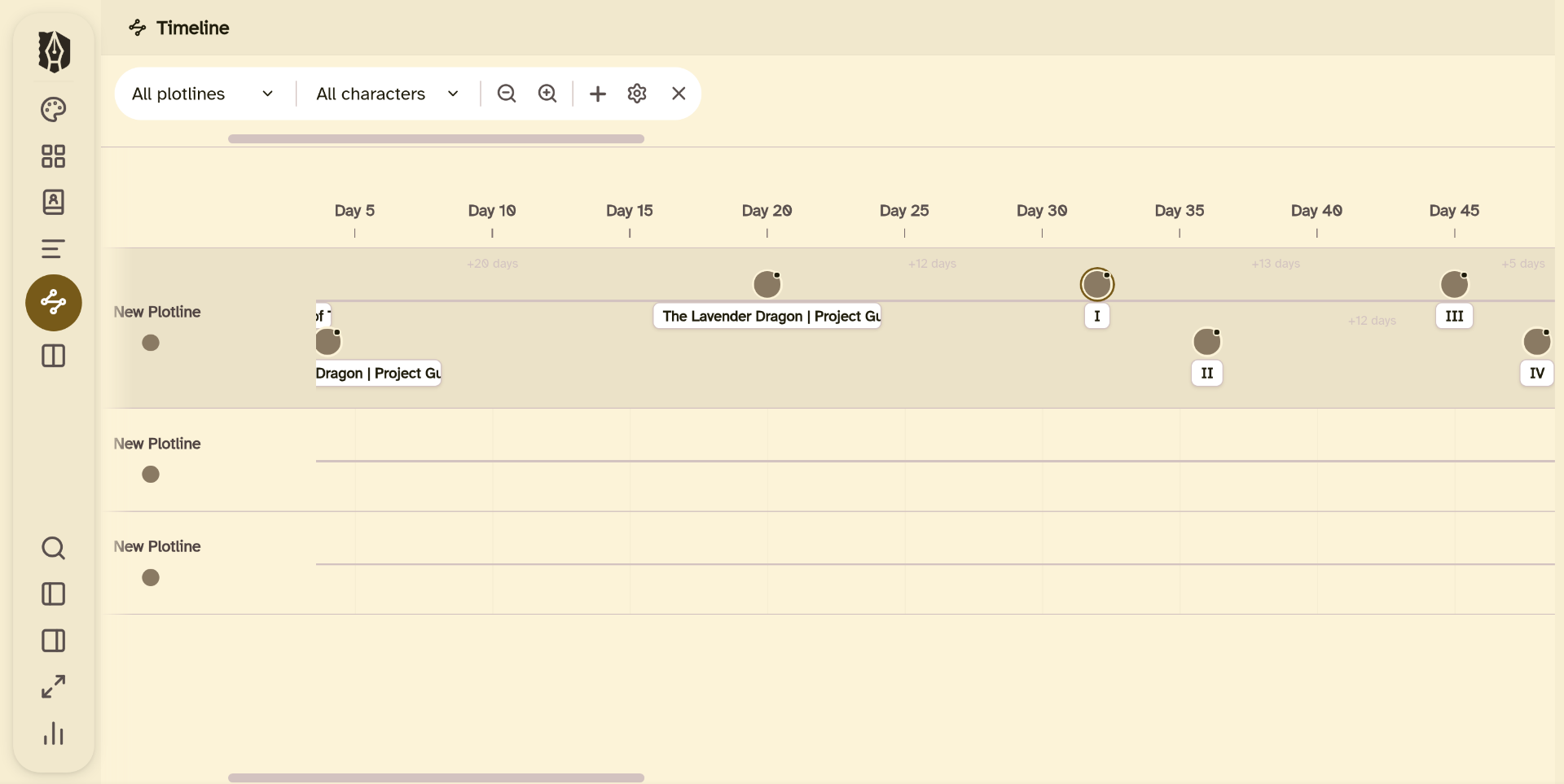
Timeline: plot events across swim-lanes, linked to your chapters
Plan & Track
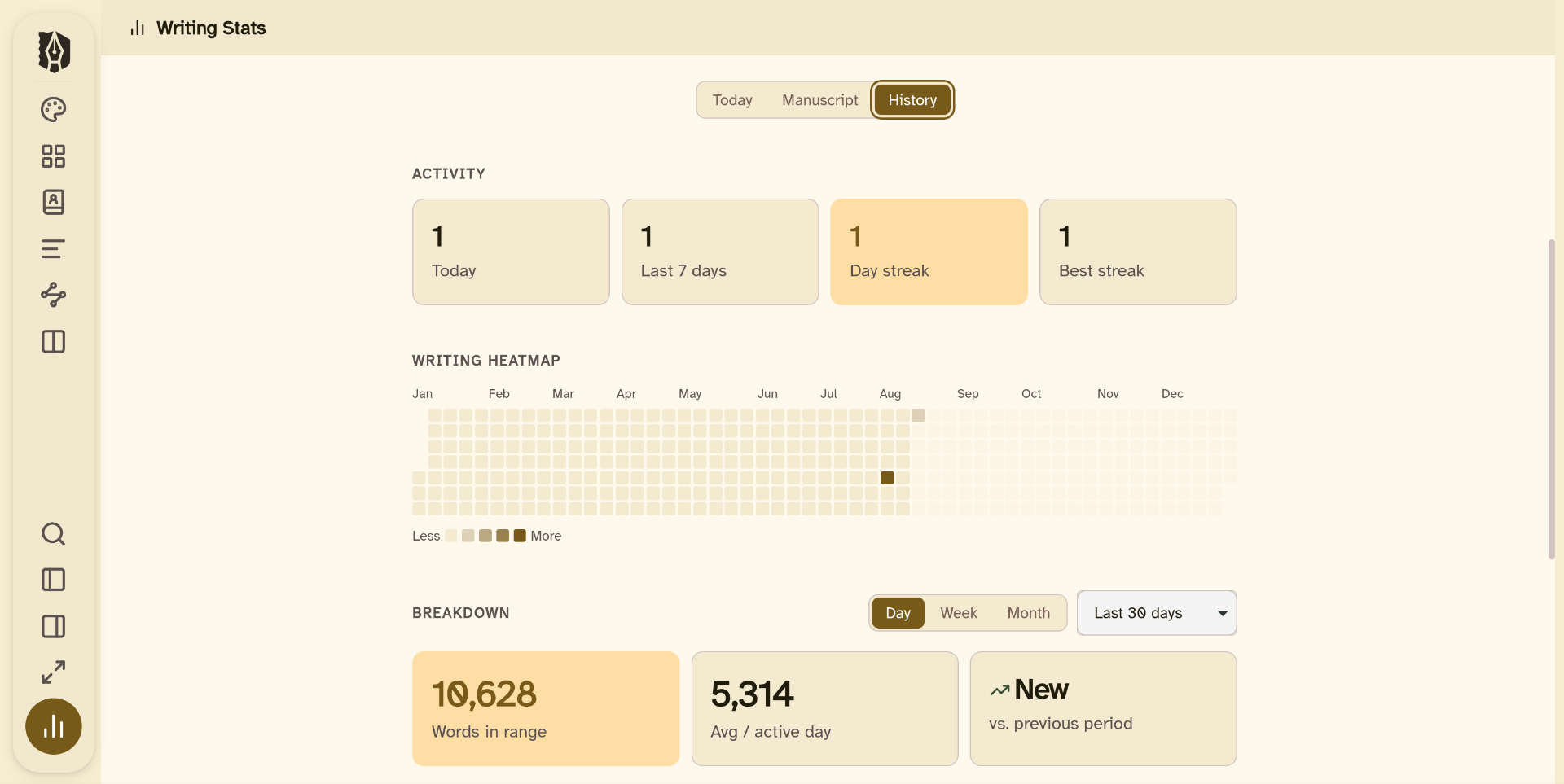
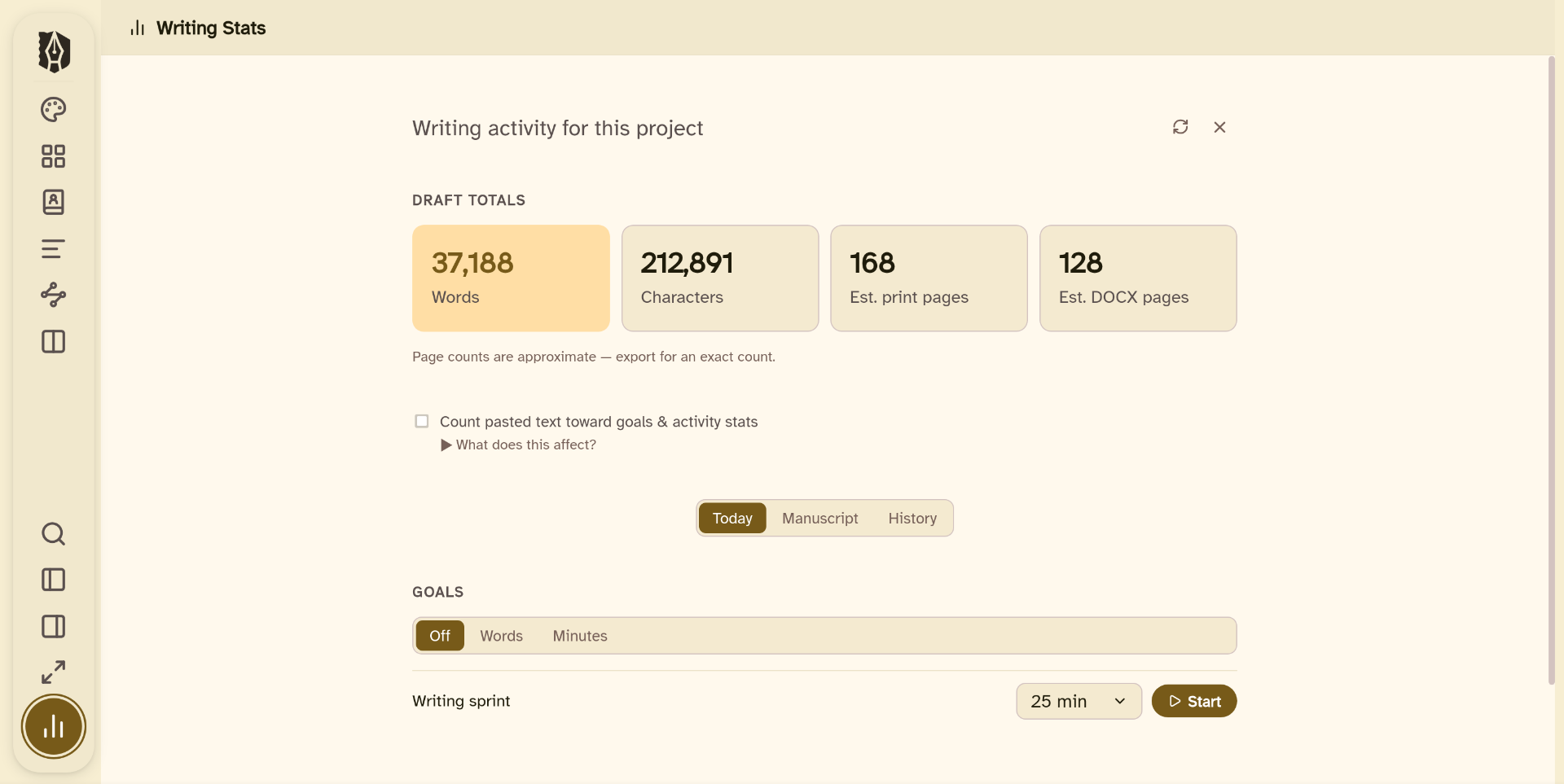
Set a target, keep a streak, and see your progress without leaving the app. Deckle tracks your writing the way a habit tracker tracks a habit: automatically, and right where you're already working.
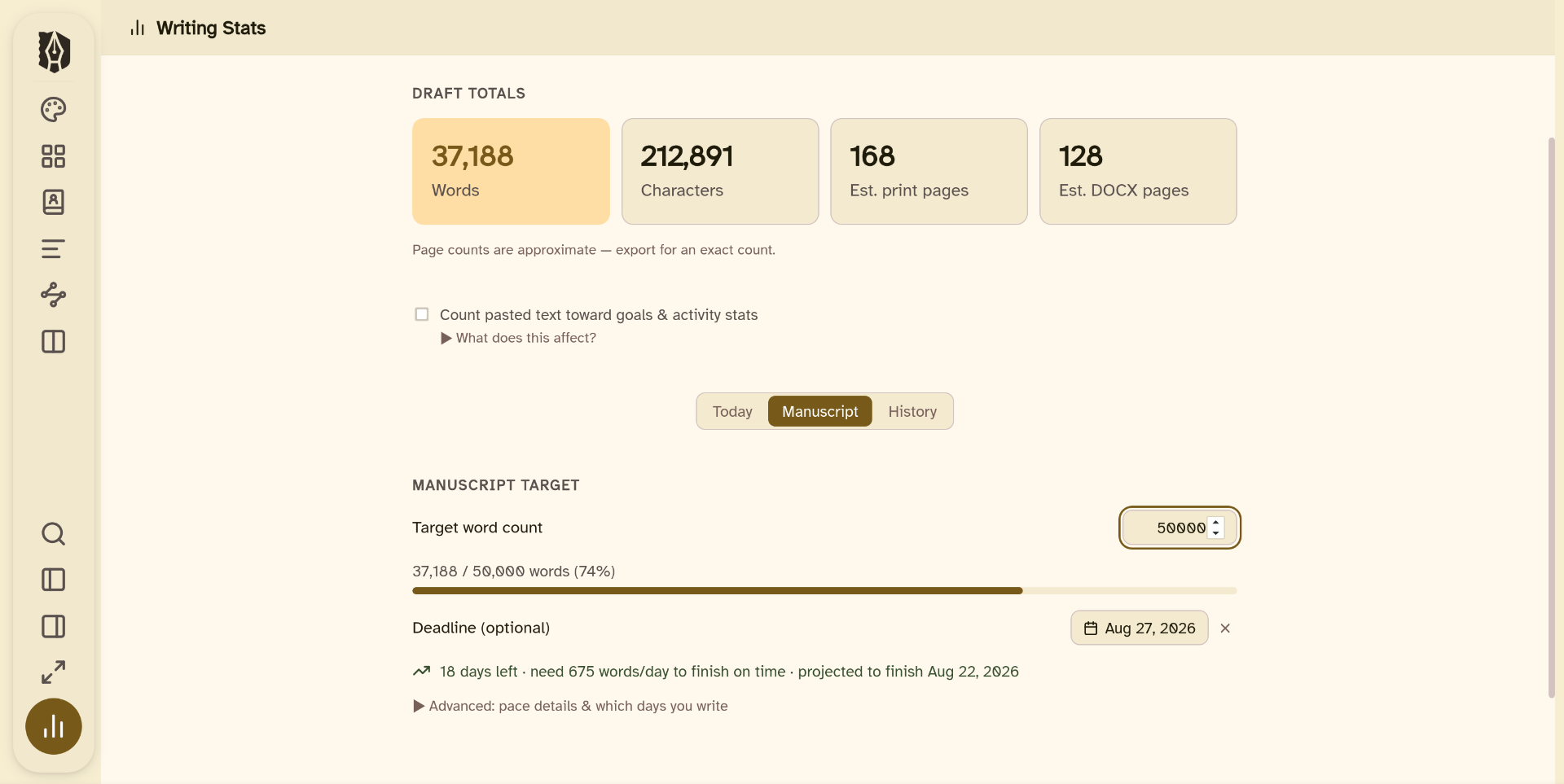
Set a target and deadline, and Deckle tracks the pace for you
The Publishing Pipeline
Deckle produces professionally typeset, publication-ready output (for print, for Kindle, for Apple Books, for your agent) from the same window you wrote it in. This is the exact half of the job Scrivener hands off to a $249.99 second app, and it is included here at no extra cost, on Windows and Linux as well as Mac.
Professional typesetting is built into Deckle. No separate purchase, no export-and-import round trip, and no Mac required.
Both halves. One app. Available today.
Get Deckle: $197The Typographic Studio
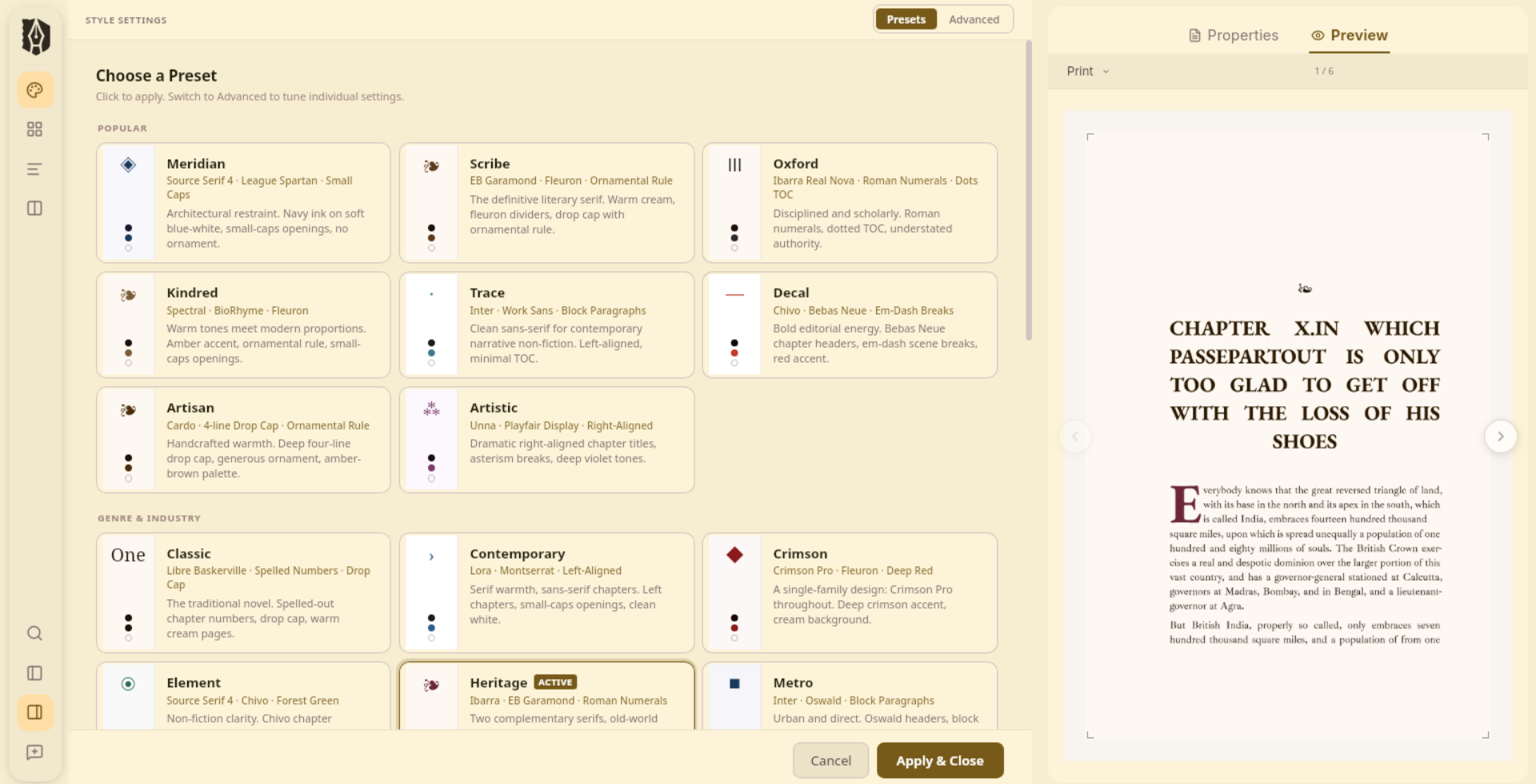
Most formatting tools give you a handful of styles and call it done. Deckle's Styler is a full typographic control room: 26 curated presets to start from, and a deep advanced mode that puts every detail in your hands. All built right into your writing app.
From classical serifs to bold editorial sans, from romantic fleurons to clean screen-first layouts. Every preset is a complete, considered design: typeface pairing, spacing, colours, chapter ornament, and scene break style all set together. Includes dedicated options for dyslexia-friendly and high-legibility reading.
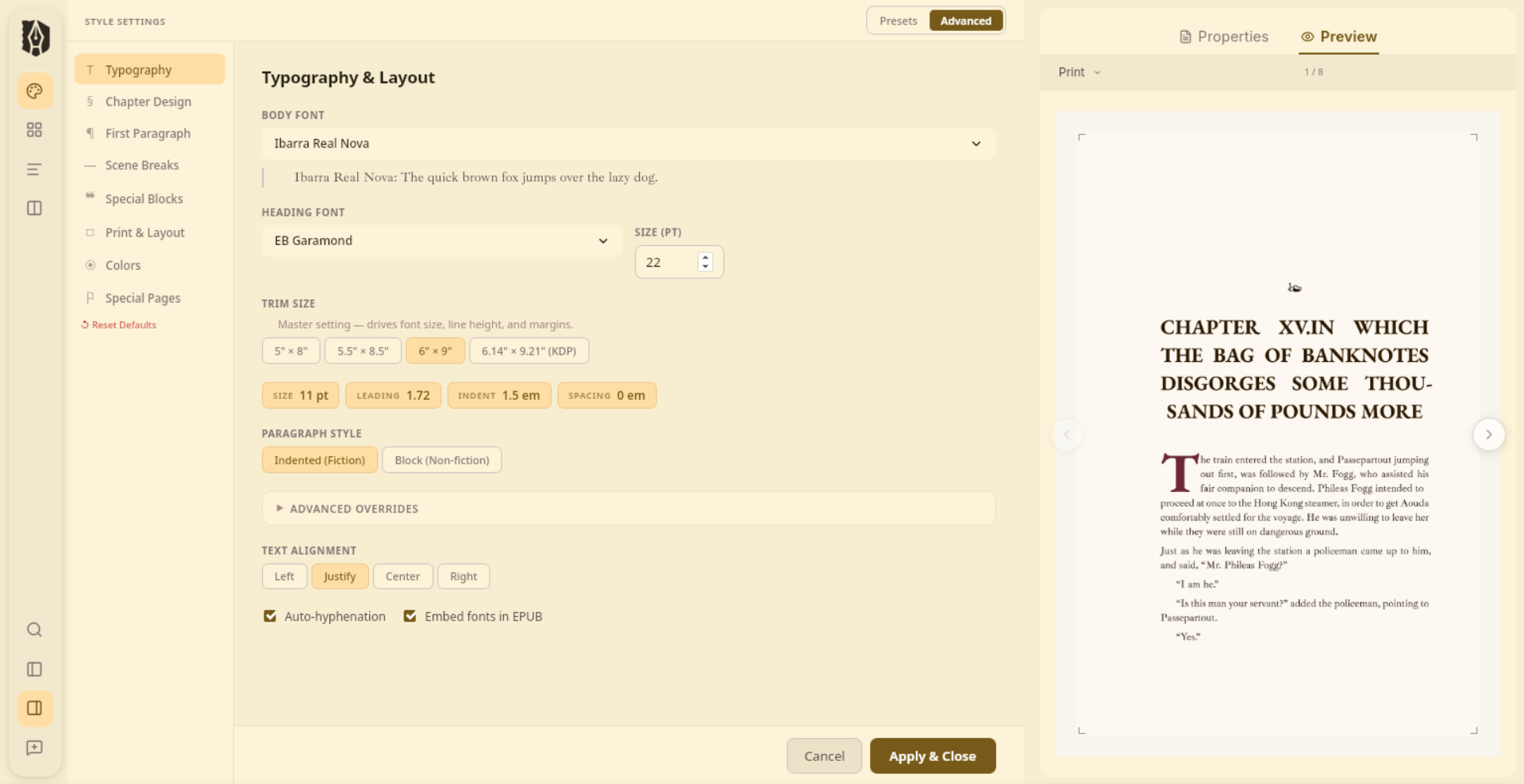
When a preset isn't quite right, Advanced Mode exposes every layer of the design. Chapter header sink, number format, ornament glyph, title alignment. Drop cap size, colour, and font. Running header content, page number position. Widow and orphan control. Margin overrides. Per-block styling for blockquotes, verse, dialogue, insets, and more, each with its own font, size, border, background, and spacing controls.
Your style settings drive the editor, the EPUB, and the print PDF simultaneously. Change your body font and it updates everywhere: what you see while writing, what your ebook readers see, and what comes out of the printer. No separate formatting pass. No re-exporting to check.
Title page, copyright, dedication, epigraph, table of contents, foreword, about the author, acknowledgments, also by, glossary, each with its own layout options. The TOC is generated automatically from your chapter hierarchy. Copyright year, position, and preset are all configurable. Nothing is hard-coded.
Simple mode: pick a preset and go
Advanced mode: every detail, your way
Make It Yours
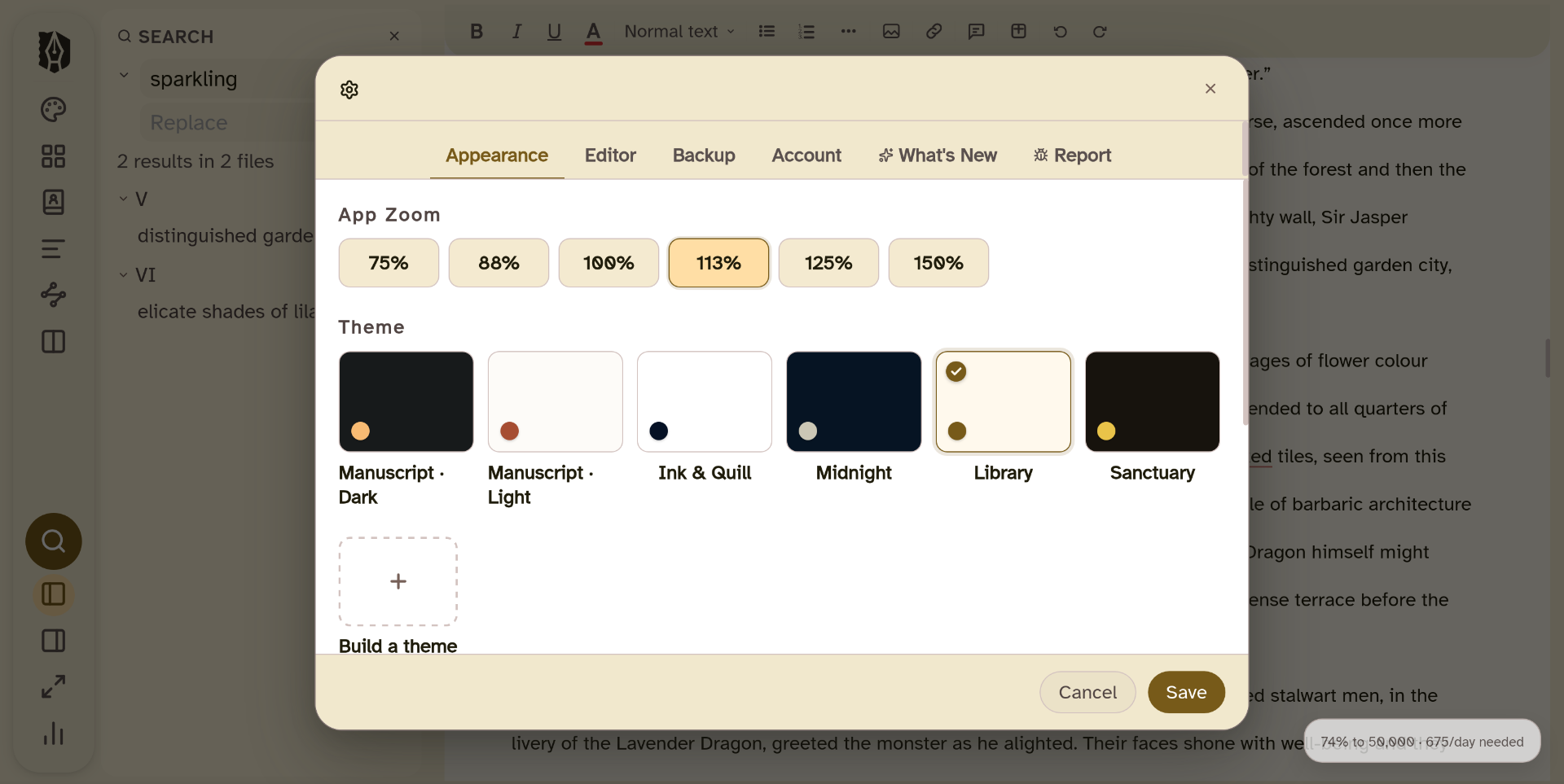
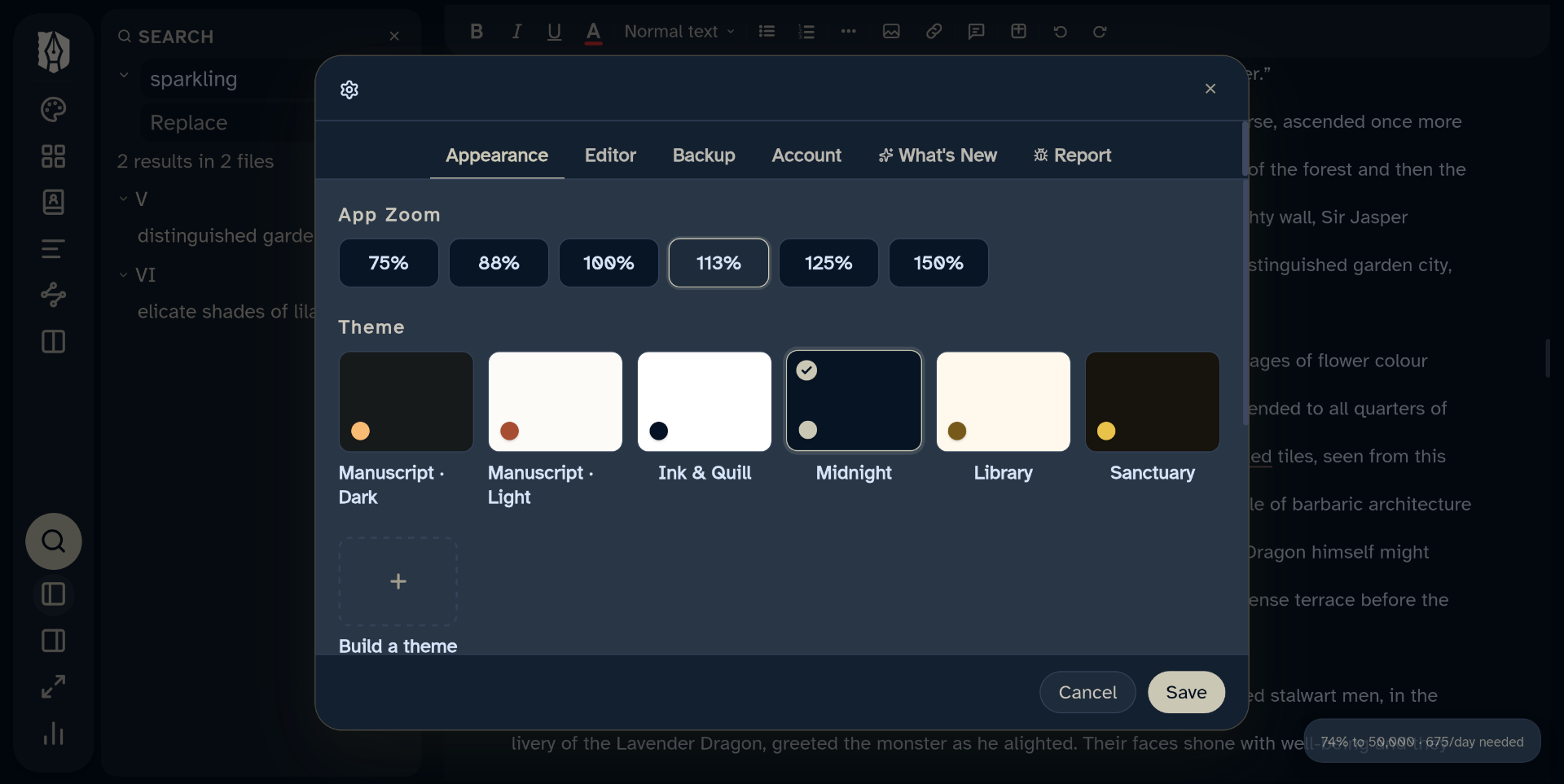
This is the app itself, not your book: six full themes for the Deckle interface, from a bright parchment page to a true dark mode, so the app looks right whether you're writing at your desk at noon or in bed at midnight. Zoom from 75% to 150% independently of your writing text size.
Light themes for daytime writing
True dark mode for late-night sessions
The Publishing Pipeline in Action
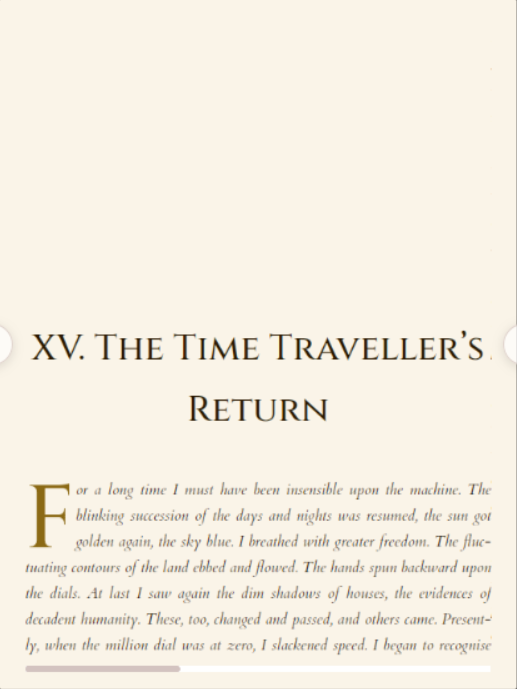
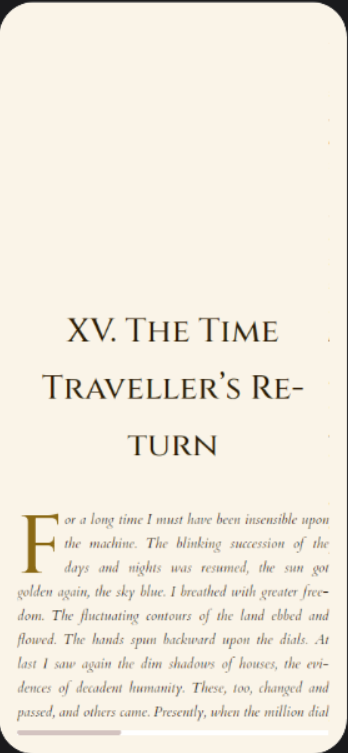
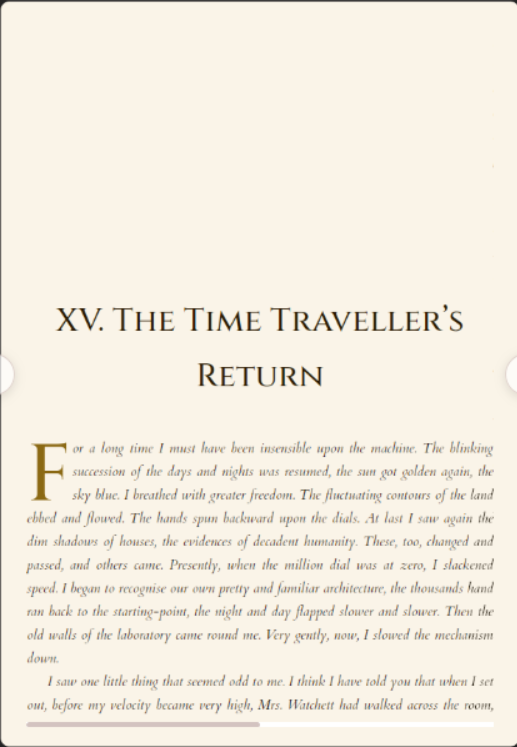
Click a device to see how your finished book looks on each platform.
Where these tools actually run
If you write on Windows or Linux, the most-recommended formatting tool in self-publishing is not merely harder to get. It does not exist for you. There is no Windows build of Vellum and no Linux build, and Literature & Latte discontinued Scrivener's Linux version. Deckle is built natively for all three.
macOS only, and a Windows version isn't planned. The usual workaround is renting a cloud Mac, which runs $490–$670 in year one for a slower, remote version of the same app.
Mac and Windows are sold as separate licences: write on both and you pay twice, $95.98 rather than $59.99. The Linux build was discontinued.
One purchase covers all three, natively. No second licence for a second machine, no rented Mac, no compromise on output. Your licence activates on up to 2 devices.
Updates
Scrivener 3 was a paid upgrade for people who already owned Scrivener 2. That is how most "one-time purchase" writing software works: you buy it, you use it for a few years, a major version arrives, and you pay again to stay current. The price on the box is rarely the price you end up paying.
Deckle doesn't work that way. Every update is included, forever: new features, new export targets, new themes, new platform support, all of it. There is no version 2 upgrade fee waiting for you, no subscription, no annual renewal, and no price creep. You pay $197 once and the software keeps getting better at no further cost.
Pricing
Before you spend $300: the full breakdown
You keep $112 to $147, you run one app instead of two, and you never export your manuscript just to find out what it looks like.
And what the other combinations cost
One-Time Payment
One-time payment. No subscription. Yours forever.
One-time payment. No renewals, no subscriptions.
Every feature on this page is in the product today. This isn't a promise, it's a working tool.
One place. Your whole novel.
Your story deserves a room of its own.
Two apps, two workflows ◆ One place, one payment
Windows · Mac · Linux · Every update included
One-time payment. No subscription. Yours forever.
Yes. Deckle is a complete, fully functional application, not a concept or a waitlist. Every feature on this page is in the product today. You're buying a working tool, not a promise.
You're covered by a 30-day, no-questions-asked money-back guarantee. If Deckle doesn't earn its place in your workflow within 30 days of purchase, email us and you'll get a full refund: no hassle, no fine print.
No. Every update to Deckle is included, forever. That matters more than it sounds: Scrivener 3 was a paid upgrade for people who already owned Scrivener 2, and that is the normal pattern for software sold as a "one-time purchase". Deckle has no version upgrade fee, no subscription, and no annual renewal. In the future we may offer new, optional functionality as a separate purchase, but you will never pay to keep the software you already bought current.
Scrivener is excellent for writing and organising, and it stops at the manuscript. When it's time to publish, you need another tool, which is why the standard recommendation is Scrivener ($59.99) plus Vellum ($249.99): $309 to $344 for the pair, and Vellum only exists on Mac.
Deckle is the one place to write, format, and publish: binder, codex, timeline, research, and focus mode on the writing side, then professional print PDF, Kindle-optimised EPUB, Apple Books, Kobo, and DOCX for agents on the publishing side, all without leaving the window you wrote in, for $197 on Windows, Mac, and Linux. And if you're already in Scrivener, you can import your project directly: chapters, synopses, notes, and research all come across in one step.
Atticus is a browser-based Progressive Web App that runs in Chrome and stores your work on its servers. It has an offline mode, but you must load your book online first and some features (import, export, local saving) aren't available offline. Deckle is a native desktop application: your work is stored on your computer, and you can write, save, and export completely offline. No internet required.
Price, platform, and workflow.
Price. Scrivener is $59.99, or $95.98 if you want it on both Mac and Windows, because those are separate licences. Vellum Press is $249.99. That's $309 to $344, and major Scrivener versions have historically been paid upgrades on top. Deckle is $197 once, with every future update included: less than Vellum costs on its own.
Platform. Vellum runs on macOS only. There is no Windows version and no Linux version. Deckle runs natively on all three, and one purchase covers all of them.
Workflow. Scrivener plus Vellum means writing in one app, exporting, importing into the second app, formatting, and exporting again, and repeating that loop on every revision. In Deckle the manuscript never moves: you write, you see the live book preview beside your draft, and you export the finished file in about a second.
No. Vellum is macOS only, and its makers have said a Windows version isn't planned. There is no Linux version either, and Scrivener's Linux build was discontinued.
The usual workaround for Windows authors is renting a cloud Mac to run Vellum remotely, which costs $490–$670 in the first year and gives you a slower, laggier version of the same app over a remote desktop. Deckle has native Windows, Mac, and Linux builds. Same features, same output, same price, whichever one you write on.
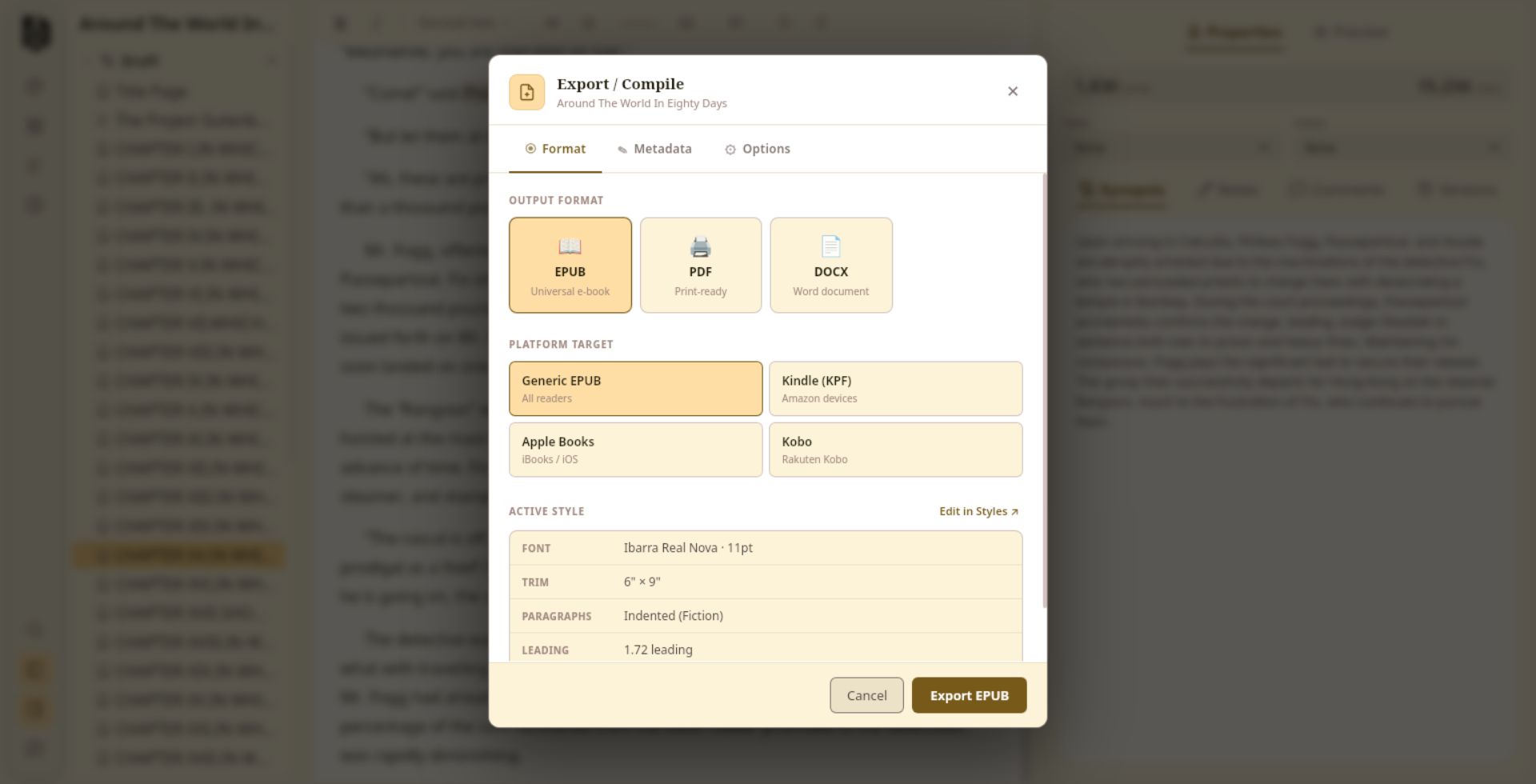
Yes. Deckle's print PDF passes KDP preflight with fonts fully embedded, and handles drop caps, running headers, crop marks, and automated spine-width calculation for paperback and hardcover. Its EPUBs are validated against the EPUB 3.3 spec and exported as four separate targets tuned per store: Kindle, Apple Books, Kobo, and generic.
On top of that you get 26 typographic presets and an advanced mode with per-element control over every detail of how your book looks. And because the in-app preview runs the real export compiler rather than an approximation, what you see while you're writing is exactly what your readers get.
Yes. Deckle imports Scrivener projects directly from the .zip export. Your chapter and scene structure, synopses, notes, inline comments, and research all come across. You don't start over, you pick up where you left off, in a tool that can take you the rest of the way.
Your Deckle project is stored as a folder on your computer. You can back it up, move it, or open it with any text editor. It's yours, no cloud server required.
Windows, Mac, and Linux, all native builds. Your purchase covers all three at no extra cost, and one licence activates on up to 2 devices. Worth comparing: Vellum is macOS only, and Scrivener sells Mac and Windows as separate licences while its Linux build has been discontinued.
Yes. Deckle exports four separate EPUB targets, each optimised for its platform: Kindle, Apple Books, Kobo, and a generic EPUB for everything else. All four are validated against the EPUB 3.3 spec. Hyphenation, chapter breaks, and metadata are tuned per platform so you upload the right file to the right store without any manual adjustments.
Deckle exports clean DOCX using the conventions novel manuscripts are typically submitted in: double-spaced body text with a 0.5" first-line indent, an unindented opening paragraph for each chapter or scene, centered scene breaks, and clearly distinct chapter headings. Manuscript format does vary by form and by agent or publisher (a short story or poetry submission looks different from a novel), so it's always worth checking specific submission guidelines. For novel-length work, Deckle's defaults line up with what most agents and editors expect.
If you're happy with Scrivener for writing, Deckle saves you money the moment you need to publish. The alternative is adding a separate formatting tool: Vellum at $249.99, which is Mac only and costs more than Deckle does on its own, or Atticus at $147, which keeps your book on someone else's servers. Deckle gives you both writing and professional formatting for $197, and there's no second app to learn or export into.
You can import your existing Scrivener project directly, so nothing you've already built is lost: chapters, scenes, synopses, notes, and research all come across in one step. And if the compile process is what drove you to look elsewhere, that's the part Deckle replaces outright: one click to print PDF, EPUB, or DOCX, with a live preview of the result beside your draft the whole time.
This is intentional, and it comes down to a fundamental difference in how Deckle is built compared to most writing tools.
In traditional writing apps, exporting is a slow, heavy process you only do when your manuscript is completely finished. Because of that, they built full in-app previews so you could see what your book looks like without going through a painful export step. It made sense given their limitations.
Deckle is built differently. Export takes under a second or two for an entire book. That changes the workflow entirely. Export is no longer the big final step you save for the end. It's something you can do anytime, instantly, to see exactly what your manuscript looks like.
So in Deckle, the preview is designed to show you what your current document looks like as you write, whether that's a chapter, scene, part, or special page. When you want to see multiple chapters, a full part, or your entire book, just export it. It takes two seconds and what you get is the real output, not an approximation.
Once that clicks, it's actually a faster and more accurate workflow than anything you'd get from a slow in-app preview.
Deckle is fully local software. Your project lives on your computer, not on a server, which is great for privacy but does mean there's no automatic live sync between devices like you'd get with a cloud based app.
The good news: you can still work across multiple devices easily. Just keep your project folder inside your Google Drive or Dropbox folder, and let that service carry the file between your computers for you.
The one rule: close the project on one device before opening it on the other.
Here's why. Deckle saves your work automatically as you type, but only to the device you're actually using. If you switch to a second device and keep it open on the first one too, the first device won't know about your newer changes until you close and reopen it there.
How to do it right:
If you forget: nothing breaks. Worst case, whichever device you save on most recently is the version that's kept, the other device's most recent changes just won't carry over. No corrupted files, no crashes.
Extra safety net: Deckle automatically saves a local backup copy on your computer, both when you close a project and periodically during a long writing session. That backup lives on the specific device where it was made, so if you ever need to recover something, check the device you were actually writing on at the time, not the other one.
A couple of things to double check if something seems off:
It depends on what you're going for. There are two common versions of this question, so here's both.
"I want to write a series, each book as its own file" (most common)
For this, use a separate Deckle project per book, not one project for the whole series. Here's why: each project only has one title page, one set of front/back matter, and one Book Details entry (title, author, etc), so it's built around being one published book. Trying to cram three books into one project would mean they all share a single title page and can't be exported as separate files.
For carrying your cast and story bible into Book 2, save Book 1 as a Project Template once its Codex, Timeline, and styling are set up the way you like. Starting Book 2 from that template packages the binder structure, Codex entries, and style settings together, so the new project begins with the same characters, locations, and look already in place instead of a blank slate.
One thing worth knowing: a template is a one-time starting point, not a live link. Once Book 2 is created from it, its Codex and Timeline are independent copies, so changes you make in Book 1 afterward won't carry over automatically; you'd update both projects separately.
"I want multiple short books combined into one file" (an omnibus or anthology)
This one's the opposite: use a single project. Structure each book as a Part, with its chapters nested underneath it. When you export, Deckle compiles the whole thing into one file in order, exactly what you want for a combined edition. Just know the whole project still only gets one title page and one set of front matter, so that title page should represent the omnibus as a whole (e.g. "The Complete Trilogy"), not any one book inside it. You can still label each section clearly using its Part name.
Edge cases worth knowing about:
From the Deckle Blog
Still deciding? We've written the honest comparisons you're looking for: no affiliate bias, just facts.
Vellum, Atticus, Deckle, and others: a clear-eyed look at every option and who each one is actually for.
You know these three names. Here's a detailed look at who each one is actually for, and who it isn't.
Still widely regarded for manuscript organisation. But is it the right choice, especially if you also need to publish?
Vellum is excellent if you're on a Mac with $249.99 to spare. For everyone else, on Windows or Linux or simply unwilling to buy two apps, here's what to consider.
Both write and format. But they make very different choices about how you work and where your manuscript lives.